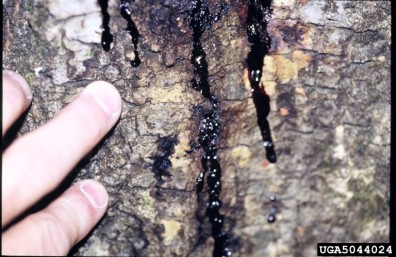
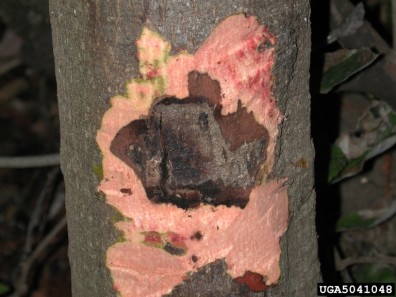
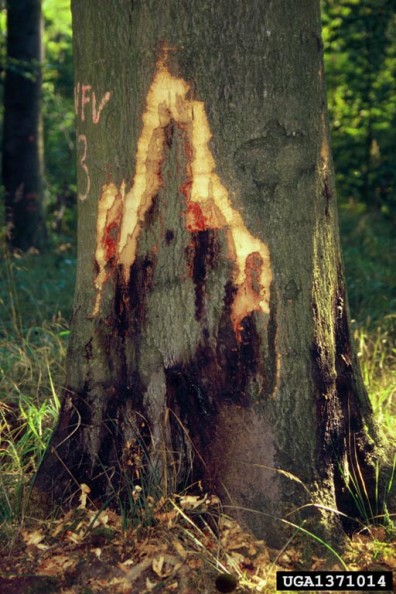
Phytophthora species, including P. ramorum, cause bleeding stem cankers of several tree hosts. These cankers interfere with water transport and may cause crown wilting or dieback. Symptoms of Phytophthora cankers include bleeding of a reddish-brown to black gummy liquid from the lesion area and brown or pink staining of the inner bark and cambium with a defined margin. If a tree has these symptoms a sample should be collected and submitted for analysis to determine if the causal organism is P. ramorum or some other Phytophthora species.
In Washington State, P. cactorum has been reported to cause bleeding stem cankers on dogwood (Cornus nuttallii) and Pacific madrone (Arbutus menziesii). P. ramorum has not been found to cause bleeding stem cankers on these hosts.
Some tree species that are susceptible to bleeding cankers by Phytophthora spp. are listed below. Of the Phytophthora species listed, P. alni and P. kernoviae have not been reported on hosts in the US.
- Alder (Alnus spp.) P. alni, P. cactorum
- Horse chestnut (Aesculus spp.) P. citricola, P. cactorum
- Beech (Fagus spp.) P. citricola, P. cactorum, P. cambivora, P. ramorum, P. kernoviae
- Oaks (Quercus spp.) P. cinnamomi, P. ramorum, P. kernoviae
- Tanoak (Lithocarpus densiflorus) P. ramorum
In addition to Phytophthora spp., bleeding stem cankers can also be caused by the bacterium Pseudomonas syringae.

WSU Puyallup Research & Extension Center
2606 West Pioneer, Puyallup, WA, 98371-4998 USA
Last updated 9/24/2025