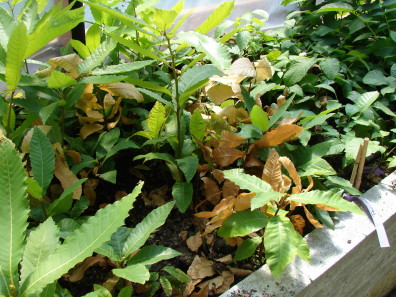
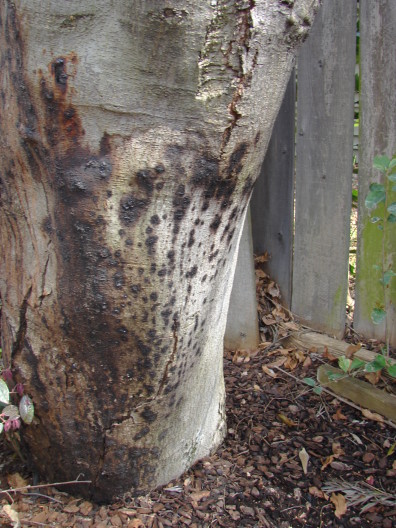
Root disease and cankering are caused by several species of Phytophthora: Phytophthora cinnamomi, P. cactorum, P. cambivora, P. citricola, P. cryptogea, P. drechsleri, P. megasperma, and P. syringae. Phytophthora root disease is characterized by general decline, twig and branch dieback, small, sparse yellow foliage, premature leaf-drop, and lesions on the lower trunk and root crown. Typically there is bleeding or oozing through bark cracks near the root-crown, often appearing as black to rusty streaking. Wood and inner bark appear discolored on recently dead material. Frequent irrigation, poor drainage and poor soil aeration favor this pest. This is a common problem on shade and orchard trees.
Although P. ramorum has not yet been found to cause root rot and cankering of the root crown, a sample should be collected if the tree is an oak or other known stem canker host of P. ramorum.

WSU Puyallup Research & Extension Center
2606 West Pioneer, Puyallup, WA, 98371-4998 USA
Last updated 9/24/2025