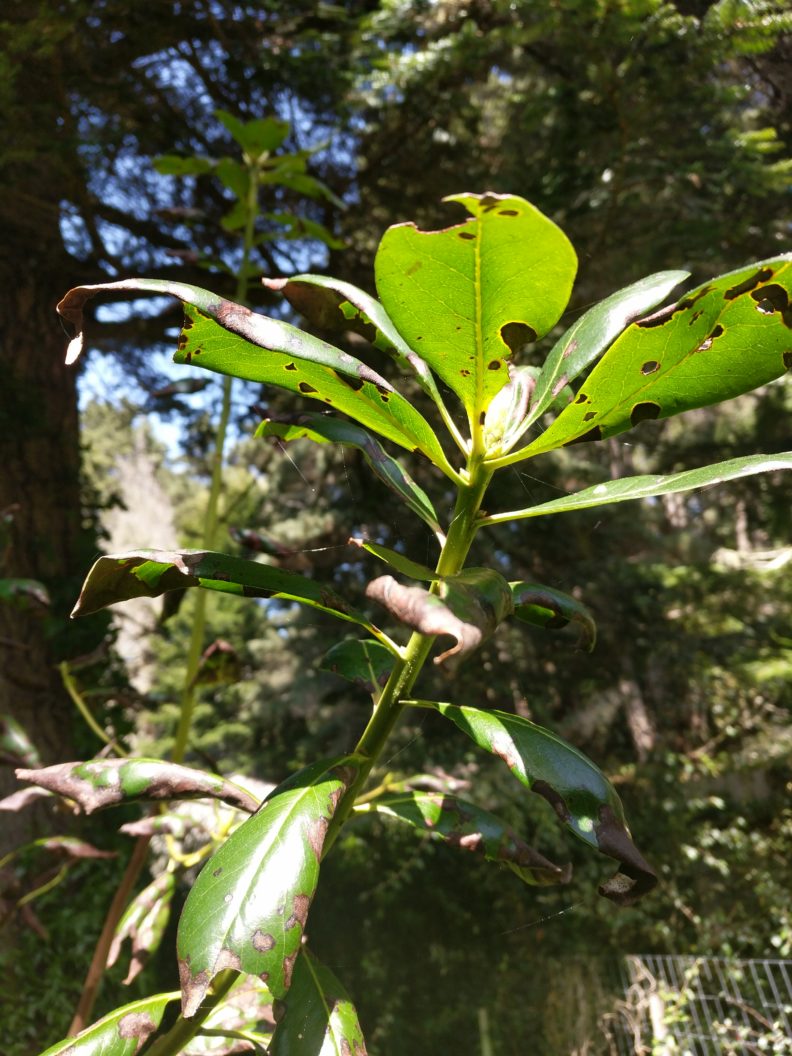
The Forest Service, Washington State Pesticide Commission, Pacific Northwest Christmas Tree Association, IR-4 program, and the WSDA Nursery Research Program are supporting research at WSU Puyallup to determine the effectiveness of various fungicides in protecting conifers and rhododendrons from infection by this pathogen. This work has shown that several traditional contact materials, such as mancozeb, and the systemic material Subdue MAXX, have the potential to provide excellent control of diseases caused by P. ramorum. However, growers and regulatory agencies are concerned that the use of fungicides may be masking symptom development, thus making it harder to prevent the spread of this pathogen on infected nursery stock. Additional studies will be conducted at the National Ornamentals Research Site at Dominican University, California (NORS-DUC) to determine the residual effectiveness of fungicides and determine if any of them have the potential to mask symptom development on infected plants.
Gary A. Chastagner, Annie DeBauw, Kathy Riley, and Norm Dart
Effectiveness of fungicides in protecting conifers and rhododendrons from Phytophthora ramorum
Cristi Palmer with Susan Bierbrunner, Ely Vea, Lori Harrison, Karen Sims. 2024.
IR-4 Ornamental Horticulture Program Phytophthora Efficacy
Chastagner, G. A., E.M. Hansen, K.L. Riley, and W. Sutton. 2005.
Effectiveness of fungicides in protecting Douglas-fir shoots from infection by Phytophthora ramorum. Phytopathology 94:S16.
Chastagner, G.A., E.M. Hansen. 2003. Identification of fungicides to control sudden oak death. Christmas Tree Lookout 36(3): 7-9. Program and abstract book, sixth international Christmas tree research and extension conference; 2003 Sept. 14-19; Hendersonville, NC; 36.
WSU Puyallup Research & Extension Center
2606 West Pioneer, Puyallup, WA, 98371-4998 USA
Last updated 9/24/2025