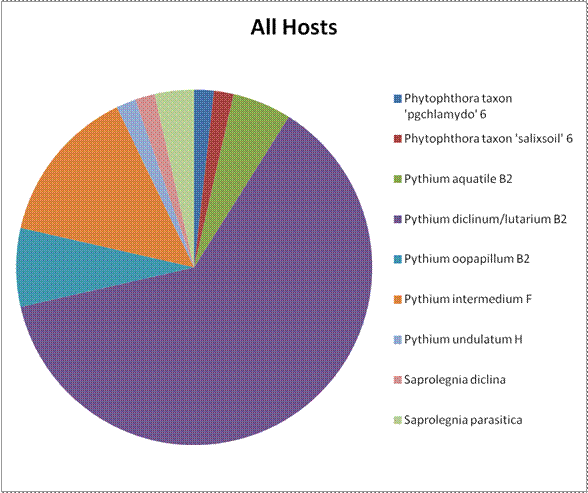
The most commonly isolated group of Oomycetes was Pythium belonging to Clade B2. There was little difference among hosts, except for reed canarygrass from which only one Pythium sp. was isolated. Saprolegnia was isolated from three hosts. Two Phytophthoras belonging to Clade 6 were isolated, and these, as well as Pythiums in Clade B2, were commonly found at the other freshwater sites sampled in this study. Phylogenetic trees from sequence data obtained in this study:
| Host common name | Host Latin name | species isolated | group or clade | Riparian/forest | # isolates |
| False lily of the valley | Maianthemum dilatatum | Fusarium spp. | fungus |
F
|
2
|
| False lily of the valley | Maianthemum dilatatum | Phytophthora taxon ‘salixsoil’ | 6 |
F
|
1
|
| False lily of the valley | Maianthemum dilatatum | Pythium diclinum/lutarium | B2 |
F
|
5
|
| Grand fir | Abies grandis | Phytophthora taxon ‘pgchlamydo’ | 6 |
F
|
1
|
| Grand fir | Abies grandis | Pythium aquatile | B2 |
F
|
1
|
| Grand fir | Abies grandis | Pythium diclinum/lutarium | B2 |
F
|
7
|
| Licorice fern | Polypodium glycorrhiza | Mucor hiernalis | zygomycete |
F
|
1
|
| Licorice fern | Polypodium glycorrhiza | Pythium aquatile | B2 |
F
|
1
|
| Licorice fern | Polypodium glycorrhiza | Pythium diclinum/lutarium | B2 |
F
|
2
|
| Licorice fern | Polypodium glycorrhiza | Pythium oopapillum | B2 |
F
|
1
|
| Rhododendron | Rhododendron ‘Nova Zembla’ | Pythium aquatile | B2 |
F
|
1
|
| Rhododendron | Rhododendron ‘Nova Zembla’ | Pythium diclinum/lutarium | B2 |
F
|
5
|
| Rhododendron | Rhododendron ‘Nova Zembla’ | Saprolegnia parasitica | Saprolegnia |
F
|
1
|
| Red alder | Alnus rubra | Pythium diclinum/lutarium | B2 |
R
|
5
|
| Red alder | Alnus rubra | Pythium oopapillum | B2 |
R
|
2
|
| Red alder | Alnus rubra | Pythium undulatum | H |
R
|
1
|
| Reed canary grass | Phalaris arundinacea | Pythium intermedium | F |
R
|
8
|
| Salmonberry | Rubus spectabilis | Pythium diclinum/lutarium | B2 |
R
|
8
|
| Salmonberry | Rubus spectabilis | Pythium oopapillum | B2 |
R
|
1
|
| Salmonberry | Rubus spectabilis | Saprolegnia parasitica | Saprolegnia |
R
|
1
|
| Skunk cabbage | Lysichiton americanum | Mortierella sp. | zygomycete |
R
|
1
|
| Skunk cabbage | Lysichiton americanum | Pythium diclinum/lutarium | B2 |
R
|
3
|
| Skunk cabbage | Lysichiton americanum | Saprolegnia diclina | Saprolegnia |
R
|
1
|
WSU Puyallup Research & Extension Center
2606 West Pioneer, Puyallup, WA, 98371-4998 USA
Last updated 9/24/2025