“The shoe experiment” – testing various disinfectants for sanitizing the bottoms of shoes

Students from Pierce College, Puyallup, investigated whether some commonly used disinfectants are able to kill P. ramorum inoculum transported on shoes. It is a common practice to spray shoe soles with a disinfectant when leaving a P. ramorum-positive nursery or lab where P. ramorum is studied, but there has been little research showing which disinfectants are effective in reducing inoculum.

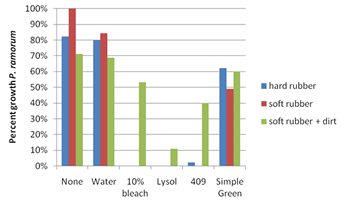
In this study, three types of shoe material and six treatments were tested. Three of the treatments were effective in destroying P. ramorum inoculum; however, this was decreased in the presence of soil. Therefore, removing soil from shoes before spraying with disinfectants is recommended.
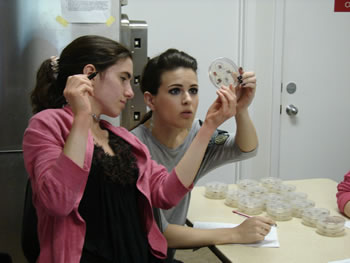
Two girls at a table, both holding the same petri dish up in their left hands to examine it. The girl further from the camera has a piece of paper on the table and a pencil in her hand.
PPO Personnel screening cultures
A bar chart showing the results of the experiment. They tested hard rubber soles, soft rubber soles, and dirty soft rubber holes. They were treated with either nothing, plain water, 10% bleach, Lysol, 409, and Simple Green. Overwhelmingly the least amount of Phytophthora grew with Lysol (only 10% of dirty soft rubber soles) with 409 the second lowest (>5% of hard rubber shoes and 40% of dirty soft rubber shoes). No treatment, plain water, and simple green had significantly more Phytophthora growth from each sole type. 10% bleach showed growth only on dirty soft rubber soles, but it was from over 50% of the relevant samples.
This graph shows the results of various methods of removing inoculum from the bottoms of shoes.

WSU Puyallup Research & Extension Center
2606 West Pioneer, Puyallup, WA, 98371-4998 USA
Last updated 9/24/2025